50.网络流
网络流
最大流问题
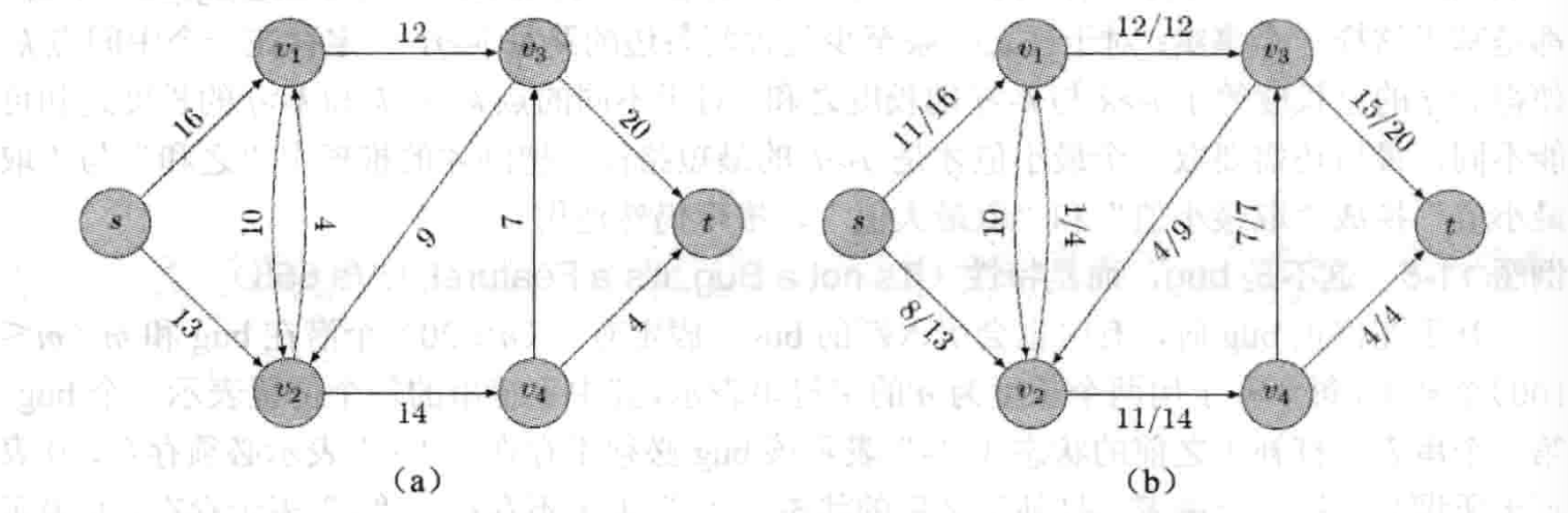
如图,我们需要把一些物品从节点
图 b 展示了一种可能的方案,每一条边的第一个数字表示实际运送的物品数目,称为流量记录
注意,把 5 个物品从
这样规定
我们很容易发现几个性质:
- 容量限制
- 斜对称性
- 流量平衡对于除了
和 之外的节点 ,
我们的目标是最大化
增广路算法
那么如何解决网络流问题呢?一种算法思想很简单,从 0 流开始不断增加流量。
外面计算每一条边上容量与流量之差(称为残余容量,简称残量),得到了一个残量网络。例如
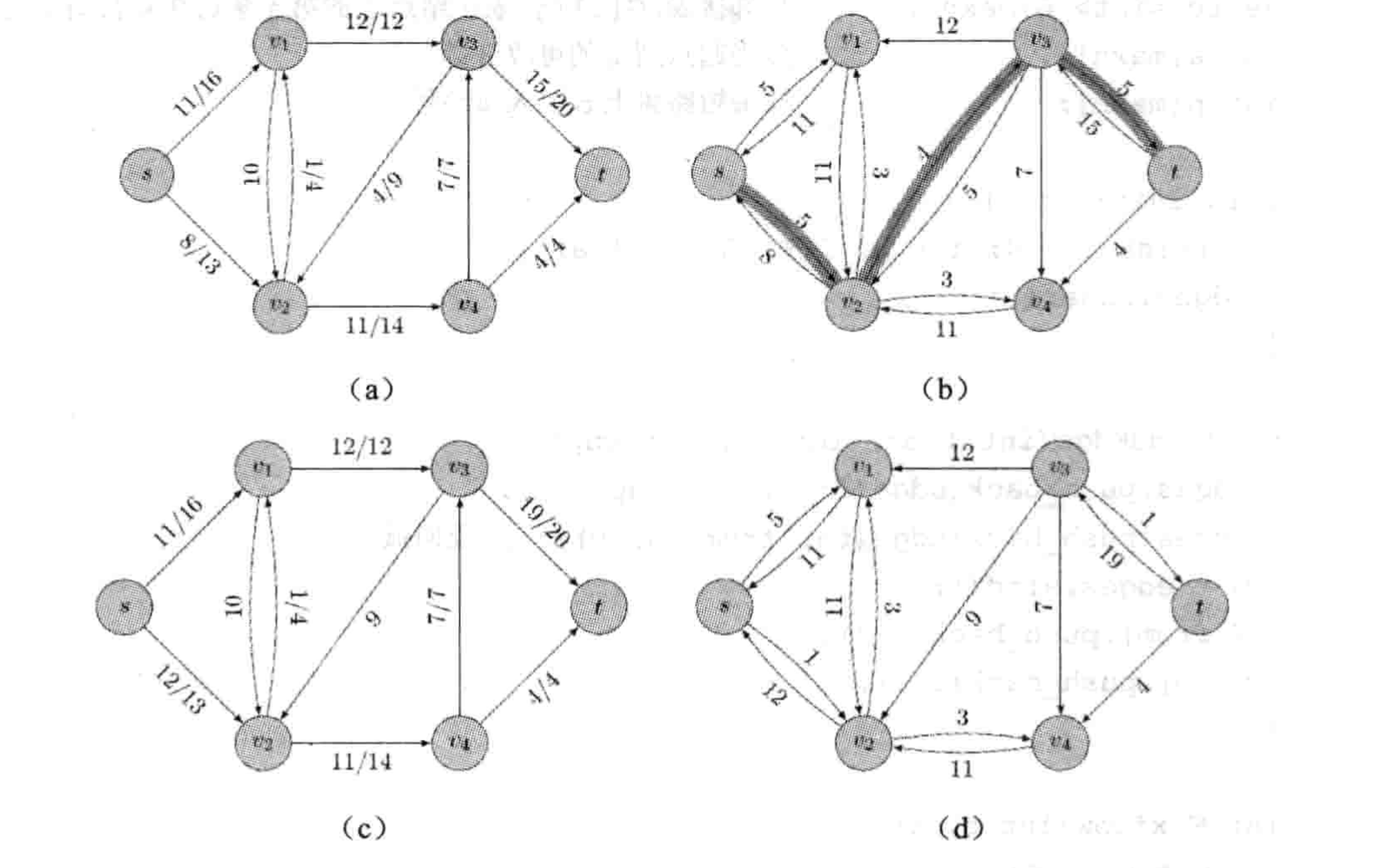
残量网络中任何一条从
Edmonds-Karp 算法
"找任意路径"最简单的方法是用 DFS,但是可以造数据把 DFS 卡死,所以我们使用 BFS 来找到一条增广路,这就是 Edmonds-Karp 算法。
相当于,我要找到一条从起点到终点的通路,且这条路上都要满足
#include <bits/stdc++.h>
#define int long long
using namespace std;
const int INF = 0x3f3f3f3f;
struct EdmondsKarp {
    int n, m; // n 为点数,m 为边数
    struct Edge {
        int from, to, cap, flow; // 起点,终点,容量,流量
    };

    vector<Edge> edges; // 边表。edges[e] 和 edges[e^1] 互为反向边
    vector<vector<int>> g; // 邻接表,G[i][j] 表示节点 i 的第 j 条边在 edges 中的序号

    void init (int n_) {
        n = n_; edges.clear();
        g.assign(n, vector<int>());
    }

    void add_e (int from, int to, int cap) {
        edges.push_back(Edge{from, to, cap, 0});
        edges.push_back(Edge{to, from, 0, 0});
        m = edges.size();
        g[from].push_back(m - 2);
        g[to].push_back(m - 1);
    }

    int max_flow (int s, int t) {
        int flow = 0;
        vector<int> a, pre (n, 0); // a 为当前节点到源点的可改进量, pre 为当前节点的前驱的边的编号
        while (true) {
            a.assign(n, 0);
            queue<int> q; q.push(s); a[s] = INF;
            while (!q.empty()) {
                int x = q.front(); q.pop();
                for (auto i : g[x]) {
                    Edge &e = edges[i];
                    if (a[e.to] == 0  && e.cap > e.flow) { // 未访问过且残留网络中有剩余容量
                        pre[e.to] = i;
                        a[e.to] = min(a[x], e.cap - e.flow); // 更新到源点的可改进量
                        q.push(e.to);

                    }
                }
                if (a[t]) break; // 已经找到增广路
            }
            if (a[t] == 0) break; // 没有增广路
            for (int u = t; u != s; u = edges[pre[u]].from) { // 从汇点向源点更新流量
                edges[pre[u]].flow += a[t];
                edges[pre[u] ^ 1].flow -= a[t];
            }
            flow += a[t];
        }
        return flow;
    }
};

struct Dinic {
    struct Edge {
        int from, to, cap, flow;
    };
    int n, m, s, t;
    vector<Edge> edges;
    vector<vector<int>> g;
    vector<int> d, cur; // d 为层次,cur 为当前弧优化

    void init (int n_) {
        n = n_; edges.clear();
        g.assign(n, vector<int>());
    }
};

signed main() {
    freopen ("P3376.in", "r", stdin);
    ios::sync_with_stdio(false);
    cin.tie(0);
    int n, m, s, t; cin >> n >> m >> s >> t;
    EdmondsKarp ek; ek.init(n + 1);
    for (int i = 0; i < m; i++) {
        int u, v, c; cin >> u >> v >> c;
        ek.add_e(u, v, c);
    }
    cout << ek.max_flow(s, t) << '\n';
    return 0;
}
以上代码中,每条弧和他的反向弧保存在一起,且一个是奇数,一个是偶数,所以边
在 BFS 的时候,时刻记下从
Dinic 算法
可以证明每次沿着最短增广路进行增广,这样最多需要
Edmonds-Karp 算法使用 BFS 来进行查找,需要
Dinic 算法,宏观上讲,就是不停的用 BFS 构造层次图,然后用阻塞流来增广。
什么是层次图?在残量网络中,起点到结点
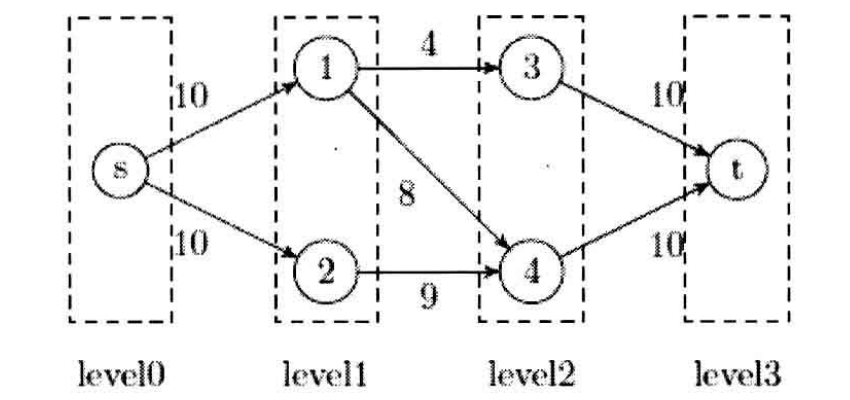
阻塞流是什么?实际上就是不考虑反向弧的极大流。
对应到程序里面就是从起点开始,在层次图中 DFS,每找到一条路就增广。
下面是 3 次增广的过程
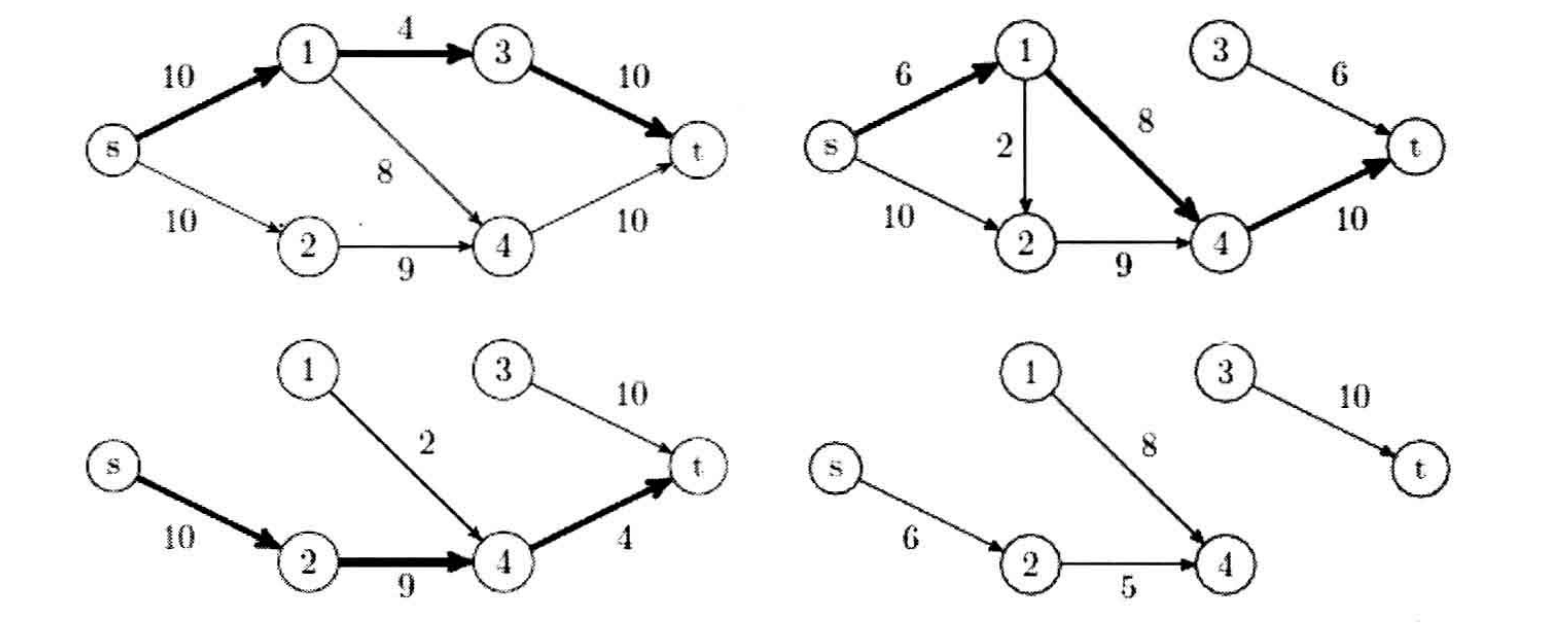
这 3 次增广后,层次图中不存在
尽管在上文中我们仅在单条增广路上定义了增广/增广流,广义地,「增广」一词不仅可以用于单条路径上的增广流,也可以用于若干增广流的并——后者才是我们定义阻塞流时使用的意义。
实现过程如下:
- 在原图上 BFS 出分层图
- 在分层图中 DFS 出阻塞流
- 将
并到原先的流 中 - 重复以上过程直到不存在从
到 的路径
此时的
当前弧优化
注意到,在分层图上 DFS 的过程中,如果节点
复杂度
可以证明,Dinic 的时间复杂度为
struct Dinic {
    struct Edge {
        int from, to, cap, flow;
    };
    int n, m, s, t;
    vector<Edge> edges;
    vector<vector<int>> g;
    vector<int> d, cur; // d 为层次,cur 为当前弧优化

    void init (int n_) {
        n = n_; edges.clear();
        d.assign(n, 0);
        g.assign(n, vector<int>());
    }

    void add_e (int from, int to, int cap) {
        edges.push_back(Edge{from, to, cap, 0});
        edges.push_back(Edge{to, from, 0, 0});
        m = edges.size();
        g[from].push_back(m - 2);
        g[to].push_back(m - 1);
    }

    bool bfs () {
        vector<int> vis (n, 0);
        queue<int> q; q.push(s); d[s] = 0; vis[s] = 1;
        while (!q.empty()) {
            int x = q.front(); q.pop();
            for (auto i : g[x]) {
                Edge &e = edges[i];
                if (vis[e.to] == 0 && e.cap > e.flow) {
                    vis[e.to] = 1;
                    d[e.to] = d[x] + 1;
                    q.push(e.to);
                }
            }
        }
        return vis[t]; // 是否存在能到达汇点的路径
    }

    int dfs (int x, int a) { // a 表示从源点到 x 的可改进量
        if (x == t || a == 0) return a;
        int flow = 0, f;
        for (int &i = cur[x]; i < g[x].size(); i++) { // 当前弧优化,在 cur[x] 之前都没有增广成功
            Edge &e = edges[g[x][i]];
            if (d[x] + 1 == d[e.to] && (f = dfs(e.to, min(a, e.cap - e.flow))) > 0) {
                e.flow += f;
                edges[g[x][i] ^ 1].flow -= f;
                flow += f;
                a -= f;
                if (a == 0) break;
            }
        }
        return flow;
    }

    int max_flow (int s, int t) {
        this->s = s; this->t = t;
        int flow = 0;
        while (bfs()) {
            cur.assign(n, 0);
            flow += dfs(s, INF);
        }
        return flow;
    }
};

signed main() {
    freopen ("P3376.in", "r", stdin);
    ios::sync_with_stdio(false);
    cin.tie(0);
    int n, m, s, t; cin >> n >> m >> s >> t;
    Dinic ek; ek.init(n + 1);
    for (int i = 0; i < m; i++) {
        int u, v, c; cin >> u >> v >> c;
        ek.add_e(u, v, c);
    }
    cout << ek.max_flow(s, t) << '\n';
    return 0;
}
牛客的一道题,这样就能求出最小割的边集了
#include <bits/stdc++.h>
using namespace std;
const int INF = 0x3f3f3f3f;

struct Dinic {
    struct Edge {
        int from, to, cap, flow;
    };
    int n, m, s, t;
    vector<Edge> edges;
    vector<vector<int>> g;
    vector<int> d, cur;

    void init(int n_) {
        n = n_; edges.clear();
        d.assign(n, 0);
        g.assign(n, vector<int>());
    }

    void add_e(int from, int to, int cap) {
        edges.push_back({from, to, cap, 0});
        edges.push_back({to, from, 0, 0});
        m = edges.size();
        g[from].push_back(m - 2);
        g[to].push_back(m - 1);
    }

    bool bfs() {
        fill(d.begin(), d.end(), -1);
        queue<int> q; q.push(s); d[s] = 0;
        while (!q.empty()) {
            int x = q.front(); q.pop();
            for (auto i : g[x]) {
                Edge &e = edges[i];
                if (d[e.to] == -1 && e.cap > e.flow) {
                    d[e.to] = d[x] + 1;
                    q.push(e.to);
                }
            }
        }
        return d[t] != -1;
    }

    int dfs(int x, int a) {
        if (x == t || a == 0) return a;
        int flow = 0, f;
        for (int &i = cur[x]; i < g[x].size(); i++) {
            Edge &e = edges[g[x][i]];
            if (d[x] + 1 == d[e.to] && (f = dfs(e.to, min(a, e.cap - e.flow))) > 0) {
                e.flow += f;
                edges[g[x][i] ^ 1].flow -= f;
                flow += f;
                a -= f;
                if (a == 0) break;
            }
        }
        if (flow == 0) d[x] = -1; // 表示从 x 出发找不到增广路
        return flow;
    }

    int max_flow(int s, int t) {
        this->s = s; this->t = t;
        int flow = 0;
        while (bfs()) {
            cur.assign(n, 0);
            flow += dfs(s, INF);
        }
        return flow;
    }
};

int main() {
    int n, m, k; cin >> n >> m >> k;
    Dinic dinic; dinic.init(2 * n * k + 2); int S = 0, T = 2 * n * k + 1;

    auto get_id = [&] (int x, int j, int op) {
        return (x - 1) * k * 2 + j * 2 + op + 1;
    };

    auto inv_id = [&] (int id) {
        id--; int x = (id - 1) / 2 / k + 1, j = (id - 1) / 2 % k, op = (id - 1) % 2;
        return x;
    };

    vector<vector<int>> g(n + 1);
    vector<int> du_in(n + 1), du_out(n + 1);
    for (int i = 1; i <= m; i++) {
        int u, v; cin >> u >> v;
        g[u].push_back(v);
        du_out[u]++; du_in[v]++;
    }

    for (int i = 1; i <= n; i++) {
        if (du_in[i] == 0 || du_out[i] == 0) {
            if (du_in[i] == 0) dinic.add_e(S, get_id(i, 0, 1), INF);
            if (du_out[i] == 0) dinic.add_e(get_id(i, k - 1, 0), T, INF);
        }
        else {
            for (int j = 0; j < k; j++) {
                dinic.add_e(get_id(i, j, 0), get_id(i, j, 1), 1);
                if (j + 1 < k) dinic.add_e(get_id(i, j, 0), get_id(i, j + 1, 1), INF);
            }
        }

        int u = i;
        for (auto v : g[u]) {
            for (int j = 0; j < k; j++)
                dinic.add_e(get_id(u, j, 1), get_id(v, j, 0), INF);
        }
    }

    auto siz = dinic.max_flow(S, T);
    if (siz > n) {
        cout << -1 << '\n';
        return 0;
    }
    cout << siz << '\n';
    vector<int> ans;
    for (int i = 1; i <= n; i++) {
        for (int j = 0; j < k; j++) {
            if(dinic.d[get_id(i, j, 0)] != -1 && dinic.d[get_id(i, j, 1)] == -1) {
                // 说明断了 i 这个点
                ans.push_back(i);
            }
        }
    }
    for (auto x : ans) cout << x << ' ';
    return 0;
}
最小割
有一个与最大流关系密切的问题,最小割。
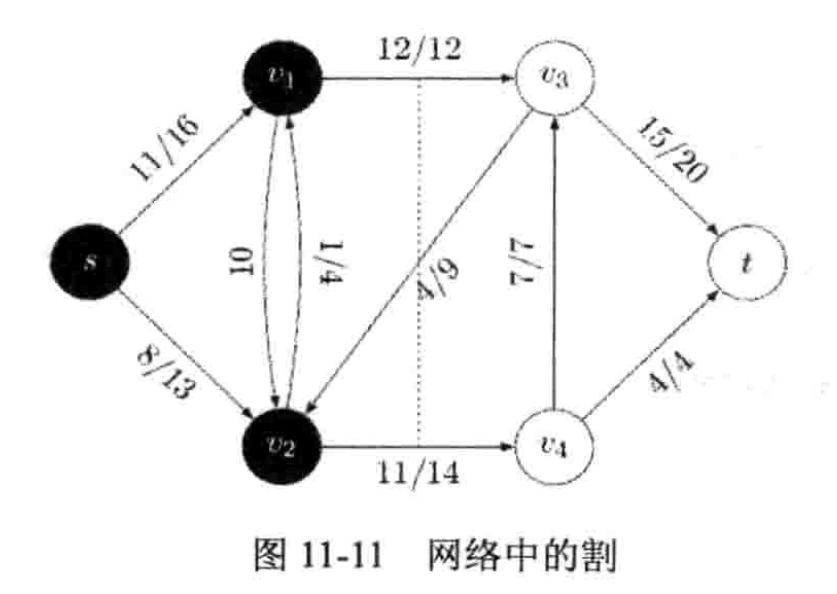
把所有的顶点分成两个集合
如果把起点在
它的容量定义为
最小割就是求得一个割
最小割最大流定理
可以从另外一个角度来看待割,从
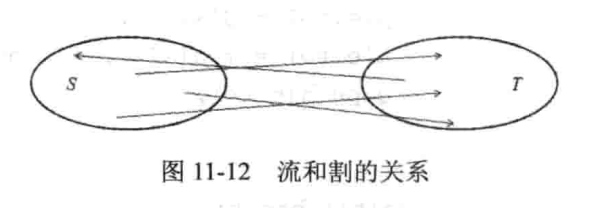
注意这里的割是任取的,因此我们得到了一个重要结论,对于任意
在残量网络中若不存在增广路,那么说明残量网络中
费用流
假设每条边除了有一个容量限制外,还有一个单位流量所需的费用 (cost)。
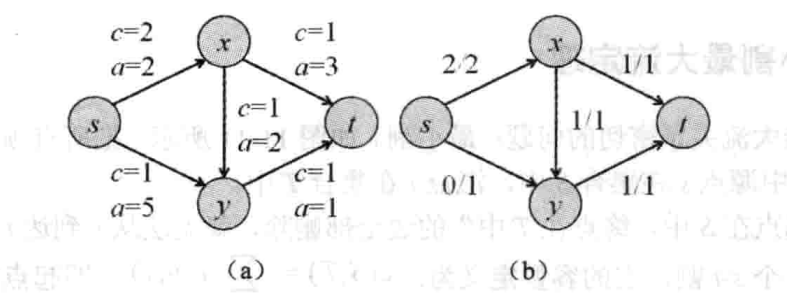
图中用
SSP 算法
SSP(Successive Shortest Path)算法是一个贪心的算法。它的思路是 每次寻找单位费用最小的增广路进行增广,直到图上不存在增广路为止。
什么时候单位费用最小?就是把费用看成距离,单位费用最小看成最短路
如果图上存在单位费用为负的圈,SSP 算法无法正确求出该网络的最小费用最大流。此时需要先使用消圈算法消去图上的负圈。
最小费用路算法,和 Edmonds-Karp ,Dinic 算法类似,但是每次用 Bellman-Ford 算法增广路,因为 Bellman-Ford 可以消去负权回路
贪心的思路:只要初始流是该流量下的最小费用可行流,每次增广后的新流都是新流量下的最小费用流。
基于 Edmonds-Karp 的实现
const int INF = 0x3f3f3f3f;
struct EdmondsKarp {
    struct Edge {
        int from, to, cap, flow, cost;
    };
    int n, m;
    vector<Edge> edges;
    vector<vector<int>> g;

    void init(int n_) {
        n = n_; edges.clear();
        g.assign(n, vector<int>());
    }

    void add_e (int from, int to, int cap, int cost) {
        edges.push_back(Edge{from, to, cap, 0, cost});
        edges.push_back(Edge{to, from, 0, 0, -cost});
        m = edges.size();
        g[from].push_back(m - 2);
        g[to].push_back(m - 1);
    }

    bool bellmon_ford (int s, int t, int &flow, int &cost) {
        vector<int> dis (n, INF), a(n, 0), pre(n, 0), vis(n, 0);
        // dis 为源点到当前点的最短距离, a 为当前节点到源点的可改进量, pre 为当前节点的前驱的边的编号, vis 为当前节点是否在队列中
        queue<int> q; q.push(s); dis[s] = 0; a[s] = INF;
        while (!q.empty()) {
            int x = q.front(); q.pop();
            vis[x] = 0;
            for (auto i : g[x]) {
                Edge &e = edges[i];
                if (e.cap > e.flow && dis[e.to] > dis[x] + e.cost) {
                    dis[e.to] = dis[x] + e.cost;
                    pre[e.to] = i;
                    a[e.to] = min(a[x], e.cap - e.flow);
                    if (!vis[e.to]) {q.push(e.to); vis[e.to] = 1;}
                }
            }
        }
        if (dis[t] == INF) return false;
        flow += a[t]; cost += dis[t] * a[t]; // 更新流量和费用
        for (int u = t; u != s; u = edges[pre[u]].from) {
            edges[pre[u]].flow += a[t];
            edges[pre[u] ^ 1].flow -= a[t];
        }
        return true;
    }

    pair<int, int> min_cost_max_flow(int s, int t) { // 返回最大流和最小费用
        int flow = 0, cost = 0;
        while (bellmon_ford(s, t, flow, cost));
        return {flow, cost};
    }
};

int main() {
    freopen ("P3381.in", "r", stdin);
    ios::sync_with_stdio(false);
    cin.tie(0); cout.tie(0);
    int n, m, s, t; cin >> n >> m >> s >> t;
    EdmondsKarp ek; ek.init(n + 1);
    for (int i = 0; i < m; i++) {
        int u, v, c, w; cin >> u >> v >> c >> w;
        ek.add_e(u, v, c, w);
    }
    auto [flow, cost] = ek.min_cost_max_flow(s, t);
    cout << flow << ' ' << cost << '\n';
    return 0;
}
基于 Dinic 的代码实现
struct Dinic {
    int n, m, s, t;
    struct Edge {
        int from, to, cap, flow, cost;
    };
    vector<Edge> edges;
    vector<vector<int>> g;
    vector<int> d, cur, vis;

    void init(int n_) {
        n = n_; edges.clear();
        g.assign(n, vector<int>());
        d.resize(n); cur.resize(n); vis.resize(n);
    }

    void add_e(int from, int to, int cap, int cost) {
        edges.push_back(Edge{from, to, cap, 0, cost});
        edges.push_back(Edge{to, from, 0, 0, -cost});
        m = edges.size();
        g[from].push_back(m - 2);
        g[to].push_back(m - 1);
    }

    bool bellman_ford () {
        fill (d.begin(), d.end(), INF);
        fill (vis.begin(), vis.end(), 0);
        queue<int> q; q.push(s); d[s] = 0; vis[s] = 1;
        while (!q.empty()) {
            int x = q.front(); q.pop();
            vis[x] = 0;
            for (auto i : g[x]) {
                Edge &e = edges[i];
                if (e.cap > e.flow && d[e.to] > d[x] + e.cost) {
                    d[e.to] = d[x] + e.cost;
                    if (!vis[e.to]) {q.push(e.to); vis[e.to] = 1;}
                }
            }
        }
        return d[t] != INF;
    }

    int dfs (int x, int a) {
        if (x == t || a == 0) return a;
        int flow = 0, f;
        vis[x] = 1;
        for (int &i = cur[x]; i < g[x].size(); i++) {
            Edge &e = edges[g[x][i]];
            if (!vis[e.to] && d[x] + e.cost == d[e.to] && (f = dfs(e.to, min(a, e.cap - e.flow))) > 0) {
                e.flow += f; edges[g[x][i] ^ 1].flow -= f;
                flow += f;
                a -= f;
                if (a == 0) break;
            }
        }
        return flow;
    }

    pair<int, int> min_cost_max_flow(int s, int t) {
        this->s = s; this->t = t;
        int flow = 0, cost = 0;
        while (bellman_ford()) {
            fill(cur.begin(), cur.end(), 0);
            fill(vis.begin(), vis.end(), 0);
            while (int f = dfs(s, INF)) {
                flow += f;
                cost += f * d[t];
                fill(vis.begin(), vis.end(), 0);
            }
        }
        return {flow, cost};
    }
};

int main() {
    freopen ("P3381.in", "r", stdin);
    ios::sync_with_stdio(false);
    cin.tie(0); cout.tie(0);
    int n, m, s, t; cin >> n >> m >> s >> t;
    Dinic ek; ek.init(n + 1);
    for (int i = 0; i < m; i++) {
        int u, v, c, w; cin >> u >> v >> c >> w;
        ek.add_e(u, v, c, w);
    }
    auto [flow, cost] = ek.min_cost_max_flow(s, t);
    cout << flow << ' ' << cost << '\n';
    return 0;
}