70.LCT
LCT
算法思想
Link Cut Tree / LCT 是一种数据结构,解决动态树问题,主要思想是 splay + 树链剖分
我们需要解决这样一个问题:
维护一颗树,在线询问,支持如下操作
- 修改两点之间路径权值
- 查询两点路径权值和
- 查询子树权值和
- 修改节点权值
- 断开并连接一些边,保证仍然是一棵树
如果没有最后一个操作,就是重链剖分的模板题
有了最后一个操作,就是动态树问题,可以使用 LCT 求解
对于树链剖分,我们每次选择子树最大的儿子作为重儿子,把树分成若干重链和若干轻链,然后使用线段树等数据结构处理
对于动态树,我们也利用类似的思想,对于每个点,连向它儿子的所有边,我们选择一条边进行剖分,被选择的边称为实边,其他的边为虚边,实边连接的儿子称为实儿子,对于一条实边连成的链,称为实链,我们把 LCT 的这种剖分方式叫做实链剖分
注意:实链剖分中的实儿子不一定是重儿子,任意一个即可
在实链剖分后,我们利用 Splay 树来维护实链
感性地说,LCT 利用若干 Splay 来维护动态的树链剖分,以期实现动态树上的区间操作。
对于每条实链,建立一棵 Splay 来维护整条链的信息
辅助树
每棵辅助树维护的是对应的一颗原树,若干辅助树维护的是对应的森林
一棵辅助树由若干棵 Splay 组成,每颗 Splay 维护原树中的一条实链,中序遍历某棵 Splay,得到的点序列,对应于原树从上到下访问这条路径得到的点的序列(也就是说,点在 Splay 中的排序权值实其在原树中的深度)
对于实边,我们建立 Splay 来维护,那么对于虚边,我们通过建立 当前 Splay 的根节点到另一个点的单向路径,注意这里儿子认父亲,但父亲不认儿子
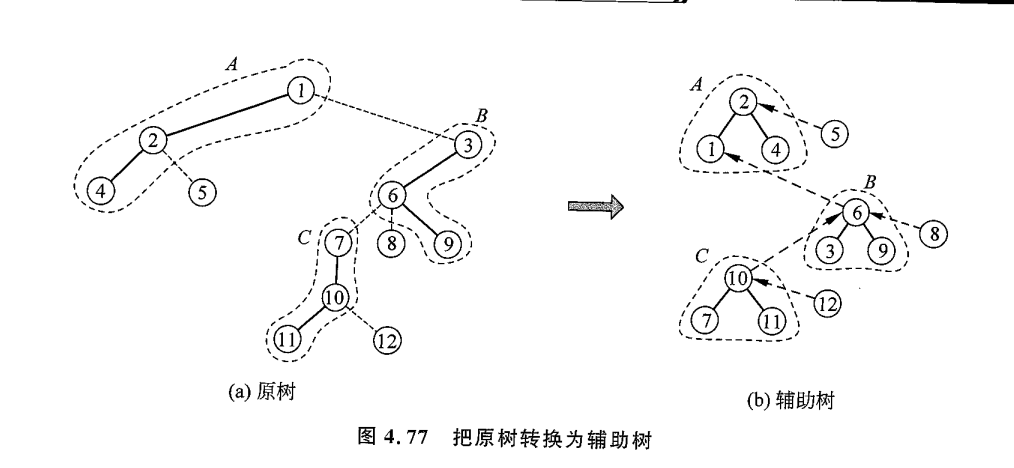
图中,
这种建边方式并不会造成信息的丢失,我们可以通过找到当前所在 Splay 深度最小的节点,也就是最 “左边” 的节点来还原原树
有了辅助树,我们可以不需要维护原树,通过辅助树能维护原树上的一些信息
辅助树可以在满足其性质前提下,利用 Splay 操作任意换根,但是对于 每个 Splay 树上的 Splay 提根操作都不会影响 BST 的性质,所以对应的原树也不会改变
虚实链变换可以在辅助树上轻松完成,这就实现了动态树链剖分
算法实现
按照洛谷模板题 【模板】动态树(LCT) 来写示例
首先需要声明一些变量
struct node{
    int fa,ch[2],sum,val,lay;
}t[maxn];
前置函数
bool is_root(int x){ // 判断x是否为根
    int f = t[x].fa;
    return t[f].ch[0] != x && t[f].ch[1] != x;
}

void push_up(int x){
    t[x].sum = t[x].val ^ t[t[x].ch[0]].sum ^ t[t[x].ch[1]].sum;
}

void reverse(int x){
    if(!x) return ;
    swap(t[x].ch[0],t[x].ch[1]);
    t[x].lay ^= 1;
}

void push_down(int x){
    if(t[x].lay){
        reverse(t[x].ch[0]);
        reverse(t[x].ch[1]);
        t[x].lay = 0;
    }
}

void push(int x){ // 递归标记下传
    if(!is_root(x)) push(t[x].fa);
    push_down(x);
}

void rotate(int x){ //旋转
    int f = t[x].fa;
    int g = t[f].fa;
    int k = t[f].ch[1] == x;
    if(!is_root(f)) //如果 f 不是根
        t[g].ch[t[g].ch[1] == f] = x;
    t[x].fa = g;

    t[f].ch[k] = t[x].ch[k^1];
    if(t[x].ch[k^1]) t[t[x].ch[k^1]].fa = f;

    t[x].ch[k^1] = f; t[f].fa = x;
    push_up(f); push_up(x);
}

void splay(int x){  //题根,将x旋转到根
    int f,g;
    push(x);
    while(!is_root(x)){
        f = t[x].fa, g = t[f].fa;
        if(!is_root(f))
            (t[f].ch[0] == x) ^ (t[g].ch[0] == f) ? rotate(x) : rotate(f);
        rotate(x);
    }
    push_up(x);
}
access
其中 access 是最核心的功能,用于将原树上的根到
void access(int x){  // 在 原树 上建一条实链,起点是根,终点是x
    for(int p = 0; x; p = x, x = t[x].fa){
        splay(x);
        t[x].ch[1] = p;  // 将x的右儿子设置为 p
        push_up(x);
    }
}
代码短小而精悍
access 的操作具体的做了两件事情
- 将根到
的路径上的点放在同一棵 Splay 中 - 让
的实儿子不在 Splay 中
一次 access 操作做了如下操作
- 将当前指向节点旋转到根
- 把儿子换成之前的节点
- 更新当前信息
- 指针向上,跳到下一棵 Splay 树上面
为什么这样就能让根到
我们一路旋转向上,所经过的每个点都被转到根,并且都与上一个在根的点用实边相连。
然后,每个点都抛弃了它原先的右儿子,而将原本以虚边连接的路径上的上一个点设置为右儿子,这样子就能保证之前的那个点
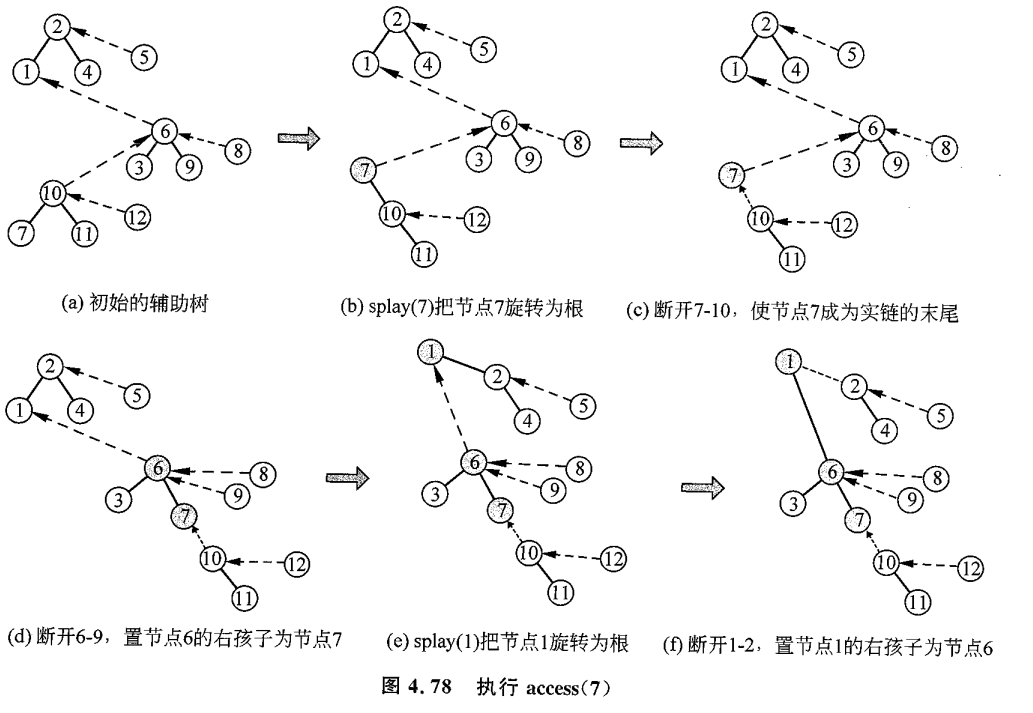
这张图有效体现了 access(7) 的全过程
再想想为什么会成功?
- 一棵 Splay 的根到其父节点的边,一定对应原树上的一条虚边,每次我们先
splay(x)用于把节点调整到 这棵 Splay 的根节点,那么 必定连接的是一条虚边,而这条虚虚边在原树上肯定也对应一条虚边,然后把这条实变变成虚变的过程中,丢弃了原来的实儿子 - 为什么连接右儿子,因为根据辅助树的性质,其中序遍历对应原树上的遍历,原树的父节点的深度小于子节点,所以 Splay 树上就是右儿子
make_root
这个函数的重要性不低于 access
我们在维护路径信息的时候,会出现深度无法严格递增的情况,根据辅助树的性质,这种路径实无法出现在一棵 Splay 中的
此时我们需要用到 make_root 函数,把
先建立
那么怎么把
具体实现是,不需要马上翻转每个节点,类似于线段树的方法做一个懒标记,遍历到的时候下传即可
void reverse(int x){
    if(!x) return ;
    swap(t[x].ch[0],t[x].ch[1]);
    t[x].lay ^= 1;
}

void make_root(int x){ // 将 x 在原树上旋转到根的位置
    access(x);  // 建立一条实链
    splay(x);  // 把 x 旋转到当前 splay 树的根
    reverse(x); // 反转
}
push_down
一般来说,懒标记有两种写法
我所常用的写法是:当前节点有翻转标记,表示当前节点已经翻转了,但是子节点没有翻转
void push_down(int x){
    if(t[x].lay){
        reverse(t[x].ch[0]);
        reverse(t[x].ch[1]);
        t[x].lay = 0;
    }
}
split
void split(int x,int y){ // 把原树上以 x 为起点,以 y 为终点的路径,生成一条实链
    make_root(x); // 将 x 旋转到根
    access(y); // 建立一条实链
    splay(y); // 把 y 旋转到当前 splay 树的根,方便之后的操作
}
link
void link(int x,int y){ // 在原树上连接 x 和 y
    make_root(x); // 将 x 旋转到根
    t[x].fa = y; // 将 x 的父亲设置为 y
}
cut
void cut(int x,int y){  // 切断 x,y 之间连的边
    split(x,y);
    if(t[y].ch[0] != x || t[x].ch[1]) return ; // 如果 x,y 不直接相连,直接返回
    t[y].ch[0] = t[x].fa = 0; // 切断 x,y 之间的边
    push_up(y); push_up(x);
}
注意 t[y].ch[0] != x || t[x].ch[1] 就能判断
find_root
int find_root(int x){ //查找 x 在原树上的根
    access(x); splay(x);
    while(t[x].ch[0]) x = t[x].ch[0];
    return x;
}
完整代码
#include<bits/stdc++.h>
using namespace std;
const int maxn = 3e5 + 5;

int read(){
    int x = 0, f = 1; char ch = getchar();
    while(!isdigit(ch)){if(ch == '-') f = -1; ch = getchar();}
    while(isdigit(ch)){x = x * 10 + ch - '0'; ch = getchar();}
    return x * f;
}

struct node{
    int fa,ch[2],sum,val,lay;
}t[maxn];

bool is_root(int x){ // 判断x是否为根
    int f = t[x].fa;
    return t[f].ch[0] != x && t[f].ch[1] != x;
}

void push_up(int x){
    t[x].sum = t[x].val ^ t[t[x].ch[0]].sum ^ t[t[x].ch[1]].sum;
}

void reverse(int x){
    if(!x) return ;
    swap(t[x].ch[0],t[x].ch[1]);
    t[x].lay ^= 1;
}

void push_down(int x){
    if(t[x].lay){
        reverse(t[x].ch[0]);
        reverse(t[x].ch[1]);
        t[x].lay = 0;
    }
}

void push(int x){ // 递归标记下传
    if(!is_root(x)) push(t[x].fa);
    push_down(x);
}

void rotate(int x){ //旋转
    int f = t[x].fa;
    int g = t[f].fa;
    int k = t[f].ch[1] == x;
    if(!is_root(f)) //如果 f 不是根
        t[g].ch[t[g].ch[1] == f] = x;
    t[x].fa = g;

    t[f].ch[k] = t[x].ch[k^1];
    if(t[x].ch[k^1]) t[t[x].ch[k^1]].fa = f;

    t[x].ch[k^1] = f; t[f].fa = x;
    push_up(f); push_up(x);
}

void splay(int x){  //题根,将x旋转到根
    int f,g;
    push(x);
    while(!is_root(x)){
        f = t[x].fa, g = t[f].fa;
        if(!is_root(f))
            (t[f].ch[0] == x) ^ (t[g].ch[0] == f) ? rotate(x) : rotate(f);
        rotate(x);
    }
    push_up(x);
}

void access(int x){  // 在 原树 上建一条实链,起点是根,终点是x
    for(int p = 0; x; p = x, x = t[x].fa){
        splay(x);
        t[x].ch[1] = p;  // 将x的右儿子设置为 p
        push_up(x);
    }
}

void make_root(int x){ // 将 x 在原树上旋转到根的位置
    access(x);  // 建立一条实链
    splay(x);  // 把 x 旋转到当前 splay 树的根
    reverse(x); // 反转
}

void split(int x,int y){ // 把原树上以 x 为起点,以 y 为终点的路径,生成一条实链
    make_root(x); // 将 x 旋转到根
    access(y); // 建立一条实链
    splay(y); // 把 y 旋转到当前 splay 树的根,方便之后的操作
}

void link(int x,int y){ // 在原树上连接 x 和 y
    make_root(x); // 将 x 旋转到根
    t[x].fa = y; // 将 x 的父亲设置为 y
}

void cut(int x,int y){  // 切断 x,y 之间连的边
    split(x,y);
    if(t[y].ch[0] != x || t[x].ch[1]) return ; // 如果 x,y 不直接相连,直接返回
    t[y].ch[0] = t[x].fa = 0; // 切断 x,y 之间的边
    push_up(y); push_up(x);
}

int find_root(int x){ //查找 x 在原树上的根
    access(x); splay(x);
    while(t[x].ch[0]) x = t[x].ch[0];
    return x;
}

int main(){
    // freopen("P3690.in","r",stdin);
    int n = read(), m = read();
    for(int i=1;i<=n;i++) {
        t[i].val = read();
        t[i].sum = t[i].val;
        t[i].ch[0] = t[i].ch[1] = t[i].fa = 0;
    }

    while(m--){
        int op = read(), a = read(), b = read();
        if(op == 0) {split(a,b); printf("%d\n",t[b].sum);}
        if(op == 1) {if(find_root(a) != find_root(b)) link(a,b);}
        if(op == 2) {if(find_root(a) == find_root(b)) cut(a,b);}
        if(op == 3) {splay(a); t[a].val = b; push_up(a);}
    }
    return 0;
}
基本应用
判断连通性
判断两节点
求两点之间的距离
先执行
求 LCA
用 LCT 求 LCA,只需要利用 access() 函数
利用
然后对
这个过程在辅助树上看其实更简单,如果走到了根所在 Splay 树,就找到了